
Our (social) business model: how GFSC plans to fund community infrastructure
My last post we explained what GFSC does and why. Now the practical bit: how do we actually pay for it? And to answer that, we need to talk about something we've lost: shared distribution.
We used to share distribution
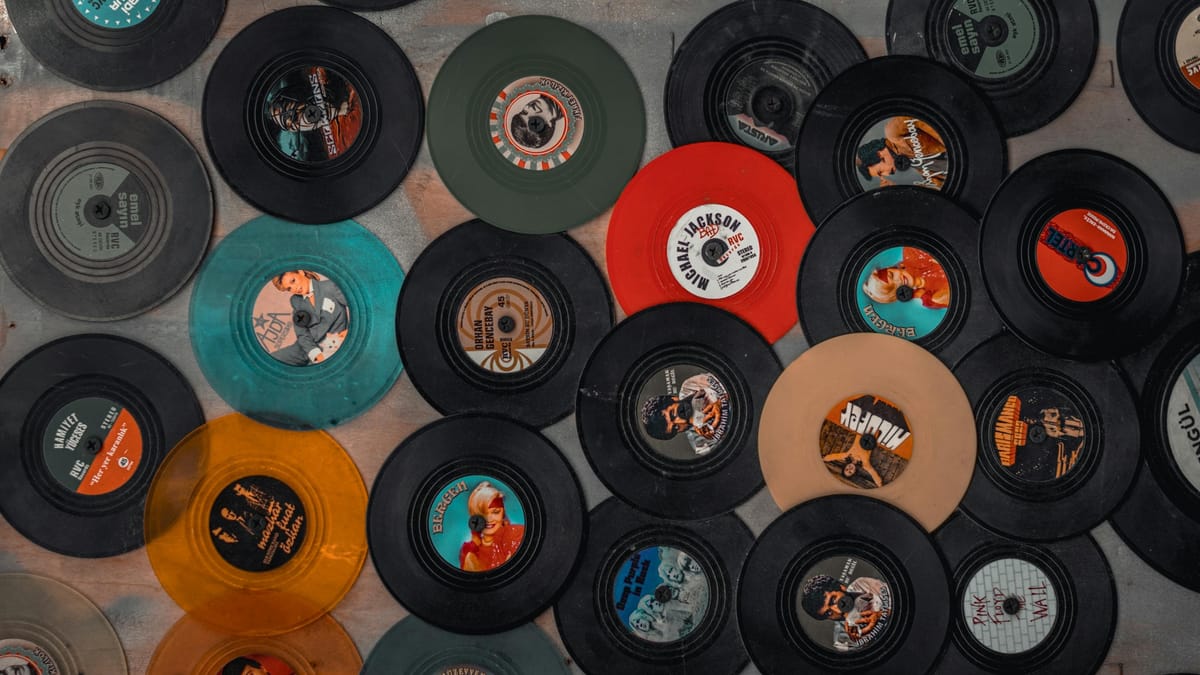
Distribution of goods feels like a solved problem now: almost anything we want we can order online and get it whisked to us by mail in days or weeks. This change has happened in my lifetime, though. In my early 20s, getting access to music required a physical store in your city to have it in stock. You found new music just by what was on the racks in the record store, seeing what album art caught your eye, what band names sound fun, and so on. Of course book and record stores still exist and are a way to discover new things. But more often than not I think we now get our recommendations and tastes from information we read online, then go to a store to pick it up.
In How GFSC Got to Here, I talked about the formative experience of running a small DIY record distro. Back in the early noughties, small artists on DIY labels were still using paper catalogues and cheques in the mail to distribute records. You’d read a list of descriptions of bands and trust labels to bring you interesting music. Ordering often meant waiting weeks or months, or not getting what you ordered at all. At some point the music streaming platforms (Napster, Limewire, DC++) came along and prompted an explosion in interest in these records, which previously required a big commitment to acquire. So this is where record distros came in: we’d get a few hundred quid together, bulk order a ton of records from Level Plane or Ebullition distros, try and fade getting flagged by customs, and take it to shows to sell. A big part of going to DIY shows back then was to browse all the little distros that would show up: sometimes it got a bit much, to be honest.
Like most people in that scene, we didn’t do it to make money, maybe just paying ourselves with the occasional bit of stock. But some people did grow it. Perhaps the biggest example of this is Buy Olympia. Riot Grrrl, Ladyfest and K Records were once household names for those in the know, emerging out of the Olympia, Washington DIY punk scene. While Buy Olympia has now turned its attention more to prints and cards, it used to be a site where you could access all that music in one place. I think this has far more impact in Riot Grrrl’s ability to have a worldwide reach than anyone gives credit. The spirit of this kind of work is still very much alive, check out Vicky’s intro about Pen Fight.
The corporate web killed it
Online shopping and digital stock control has now made it fairly trivial to buy anything that might exist. As a result, this distribution layer feels like it’s eroded a lot in terms of our cultural sense of identity — a bit secondary to the production of zines, music and books.
This perhaps overly-long analogy sets the stage for what I think has also happened to information: we have lost a sense of shared distribution and how the collapse of this infrastructure of place and interest has perhaps done more than anything else to allow the billionaires to mediate our lives. Whereas we used to use a wide range of local forums, sites like Indymedia or WeMakeZines, and dozens rather than single digits of commercial sites, now our context has collapsed to the handful of social media sites that dominate public discourse.
At some point, everyone started doing their own promotion, sales, PR, and distribution. We’re all expected to be our own vertically integrated mini-enterprises, operating the same handful of commercial sites taking chunks out of all our income and offering nothing to us in terms of discovery or community. Everyone’s fending for themselves and while we might be culturally aligned, from a purely materialist business perspective we are all constantly in competition for the same eyeballs and wallets. The sense of localism has gone, and everything is on the world stage.
A colleague told us an example of this in practice. A group of artists took over a disused shopping centre near us, and really enjoyed having the shared space which allowed them all to sell their own goods while maintaining common areas and a shared identity. But when the ‘meanwhile use’ arrangement ended, there was no shared digital infrastructure there for the artists to survive it, and they are all scattered into the wind again.
A lot of areas have this kind of building: we have Affleck’s Palace, Islington Mill and the Art and Design centre in Manchester, for example, in practice these are for-profit studio rentals, not the foundation of a liberatory social movement. What would it look like to have genuinely shared infrastructure, and not just progressively nested landlords stacked like Russian dolls? How can we build communal assets that allow aligned interests to work together across physical and digital space?
Our plan to rebuild this shared layer
There’s probably dozens of answers to this question: but until we are able to start designing, building and commissioning software that crosses organisational lines and lets us collaborate, we are fighting a losing battle against the vast economy of scale that corporate tech operates at. It’s simply not possible to compete with Shopify or Amazon on their own terms, or for that matter Instagram, Facebook and LinkedIn: they are always going to be so much cheaper and more accessible for individuals to use than we can compete with as underfunded communities. We have to change the game if we hope to win.
Software is very expensive to create, and just as expensive to maintain. Each organisation is currently commissioning new software in parallel, usually assuming something new is needed, or adapting something off the shelf that works with their organisation individually. But neither of these create the potential for a secret third thing: identifying shared problems across a number of organisations and creating common solutions that we invest in together.
Open source software is in a strange position here as the problems the community sets out to solve tend to be those expressed by computer programmers. As a result it’s very focussed on protocols, standards and syntaxes, and creating (usually worse) open source clones of for-profit software (e.g. Libre Office). The former work is technically interesting but always feels a million miles from having any use for community groups. The latter group is what we addressed in the above paragraph: attempting to tackle capitalism on its own terms.
If we are to create genuine commons and not just weak clones of corporate functionality, we need a way to develop technology that starts by working with existing communities and supporting them where they are to identify shared goals. We've written more about this approach – Community Technology Partnerships – in our philosophical foundations post. For now, the question this article is here to answer is: how do we actually pay for it?
How we fund the three stages
If you think this sounds really hard, you’d be right. Our What If We Made Money listicle explored all the possible income streams out there but also showed how incompatible they all are: different people wanting different things in different languages with different cultures and requirements.
Broadly speaking we have settled on a three-step process though:
Grant and philanthropic funding lets us create prototypes. Prototyping is long, expensive and messy and as much about getting social momentum behind your idea as how well it’s executed. Starting from a grant lets us do the dreaming and the community work from the start that otherwise wouldn’t happen. This funding is great when you have it and sucks when you don’t get it. It gives time to think but it can also stop you having to be accountable, as you’re only really accountable to the funder.
Consultancy or direct trading income helps us roll prototypes out and adapt them. Grant funding lets us explore ideas and make some cool stuff that we adapt to one specific context. Consultancy income then allows other people to adapt it to their context. Each new person we work with expands our understanding of the problem we are solving and what people want from us.
Direct donations make us sustainable long term. Creating non-profit web commons is really difficult as we don’t have access to the venture capital investment that would normally make the overheads trivial. To reach our social goals though we need to make all our services free at the point of use and cover our hosting, legal and admin fees come in. This is our smallest income right now but the more this income increases the more we can do without the boom and bust of funding bids, add more meet-ups, and make our output truly sustainable.
These three separate streams all contribute to the same goal. For example: three big funders paid for the development of the PlaceCal software and the training program and CTP methodology, but left us without a sustainable route forwards after the funding ended. Various partnerships saw the potential in the software and paid us to roll it out in their area as trading income. And the direct donations we get from our readers and supporters let us sustain the servers and organisational costs so we can now onboard people for free. Our goal is now to explicitly grow this strategy as both a way of GFSC sustaining ourselves, and a methodology for creating truly sustainable, fully inclusive, community-owned digital commons.
This is our explicit strategy going forwards: but we now need to bridge the gap from here to there.
What's next and where you can fit in (if you like!)
This article and the previous one attempt to formalise GFSC’s theory of change, and create a transition from the messy transgender autistic fever dream of a birthing process GFSC has taken to get here to a focussed, directed strategy for creating digital commons. I’ve been doing GFSC for about 10 years now. This year my goal is to de-centre myself and that starts with a clear statement of purpose so that other people can decide what that means for them, and how they’d like to contribute.
Thanks to everyone who has been a part of this so far: volunteers, collaborators, donors, supporters, staff and alumni, clients, and everyone who has given PlaceCal a go. I appreciate everyone’s patience and support in getting to here: we couldn’t have done it without you.
As we get ready for our second decade, here’s the things you can support us with:
Donate. Right now, donations are what let anyone use PlaceCal at no cost and keep the blog going, and they cover the hosting and CIC admin that keep everything running. The slightly absurd thing is that most of that money we’re raising currently flows straight back to big tech — servers, domains, the unglamorous infrastructure layer. As donations grow, more of it actually stays with us: paying facilitators to run drop-ins, hosting meet-ups in Manchester, prototyping the next thing. It's the only revenue stream that isn't tied to a specific project or client, which makes it the slowest to grow and the most important to protect. We’ve had a few unsuccessful bids recently (but we persist) so this help is keeping us going more than ever!
Get involved. Want to try PlaceCal in your area? Want to contribute code, help with our infrastructure, help with our design, or something else? Pop on to our discord or one of our regular meet-ups.
Commission us. Are you trying to get a community tech project off the ground? Do you want your organisation’s technology to feel more ethically and structurally in line with your theory of change? Are you struggling to make sense of the dizzying pace of tech progress? Hire us to help you and support GFSC in the process. Drop [email protected] an email and let's chat.
Share our posts. Do you know someone who would like our work or see a good opportunity for us? Share this with them!
We basically don’t have commons any more, to the point we’re forgetting what they feel like. The last couple of decades have seen everyday life itself get enclosed. While technology has made it much, much easier for the billionaires to enclose our data and attention, the cracks in empire have also made it possible for alternatives to be created like dandelions in the concrete. Every new participant in shared infrastructure makes it cheaper and more useful for everyone else, which is the exact inverse of how corporate platforms work. Much like starting a record or zine distro, we don't need permission to rebuild the shared layer. We just need enough of us deciding it's worth doing together.


Comments ()