
State your assumptions: GFSC's philosphical foundations
We've spent nearly a decade doing community technology work and tried to write it down it in about fifteen different ways. This is attempt sixteen: our honest takes on digital inclusion, co-production, and why the best community organising rarely looks like what funders want to fund.
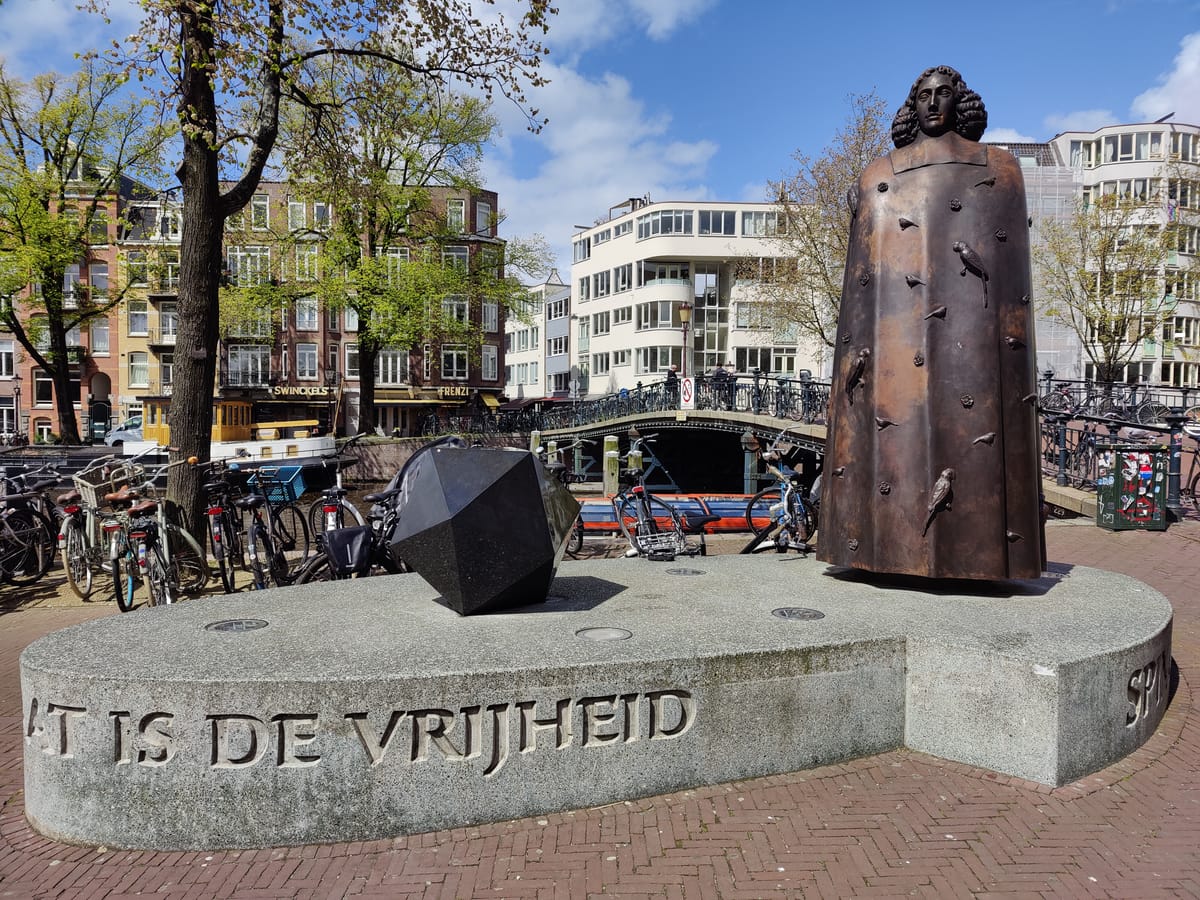
In Darren Aronofsky’s debut Pi, a mathematician going slowly mad keeps grounding himself with a mantra: “restate my assumptions”.
GFSC has been going for over nine years in various forms years, with our first blog post about how tech culture is failing communities published in 2017. Since then we’ve written a lot more posts, given talks, published a paper, made a bunch of things, and tried to explain what we’re doing in about fifteen different ways. This is an attempt to put all these scrappy pieces of emergent strategy into one place, with links to where we’ve written about them properly. Let's hope I end up in a better position at the end of it than Aranofsky's protagonist (spoilers: he has a bad time).
This is undoubtedly a work in progress for us – do let us know what you think, if we could phrase any of these better, and any key references we might like. Have you tried something like this for your work or organisation? Let us know in the comments!
Ontology: what exists, what matters?
What’s real, what’s important, and what is the world is actually made of?
People are active citizens, not passive ‘users’
The most important belief behind everything we do is perhaps that people are constantly trying to create the world they want to live in, but are held back by oppressive systems from doing so. Most institutions think about disadvantaged people through either a deficit lens (‘fix the patient’) or a social lens (‘fix society’) – but solely see their institution as the one who should do the fixing. An active citizenship approach instead treats people as actively invested equal participants in creating a better world. If you think this sounds like a mutual aid or anarchist approach, you're spot on: we find this a clearer framing of it though that has more potential to cross political and institutional boundaries. “Nothing about us, without us!”
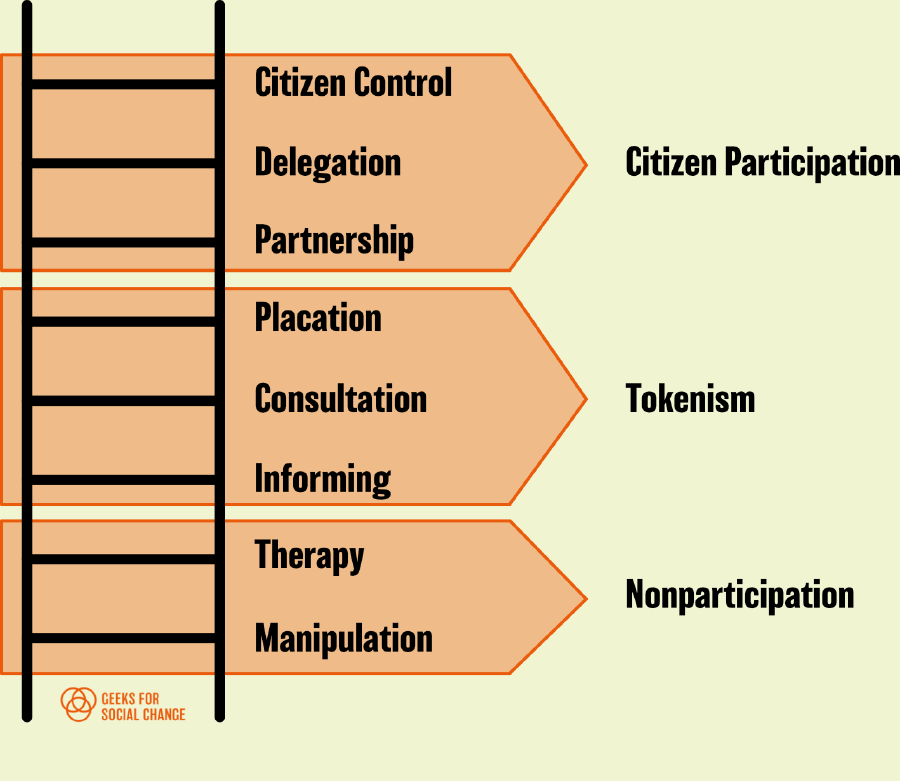
While this sounds like something that should be relatively uncontroversial, it is suprising how often and how subtly institutions insist on holding power, and how many are willing to design things on behalf of people without actually giving that group of people any real power in the process. One tool to interrogate these relationships is Arnstein’s Ladder of Citizen Participation, which we previously blogged about. It helps highlight how most ‘co-design’ and ‘co-production’ simulates participation without transferring real power. If the people most affected aren’t actually in charge, it’s consultation dressed up as participation. Needless to say, not much has changed since its authorship in 1967.
The framework we use to explore this is called The Capability Approach but is also known as Asset Based Community Development, Strengths Based Working, and Health Creation. The capability approach, variously expanded on by Nussbaum Sen and Kleine, and adopted by the World Health Organisation and United Nations Sustainable Development Goals, gives us a simple moral test: “what are people actually able to do and be?” (Nussbaum).
Rather than dealing in the world of representation and what we can theoretically do, we ask what we can actually, materially do and be right now, whether that is by ourselves, with our friends and families, or with our communities of place, interest, identity and practice. For example: it doesn't matter if we theoretically have access to a trans-friendly swimming club if we can't use it because the pool is inaccessible, it's only running when we are at work, or we're nervous and don't have a friend to go with. Capability is about what we are actually able to do right now.
In practice this means that instead of building things for people our goal is to support communities to build and own things themselves. As Hazel Stutely from C2 Connecting Communities puts it, “Disadvantaged communities and their people are not the problem – they are the solution”.
See: White & Foale 2020, Arnstein (1969).
Technology is about humans, and it is not neutral
We read technology in the broadest etymological sense: “the systematic treatment of an art, craft, or technique”. Ursula Franklin distinguishes between holistic technology, where the maker controls the whole process, and prescriptive technology, where the boss controls the process and the humans become parts in a machine. We prefer these more expansive definitions: it is just as much part of technology as how it is being used, who is using it, and why. Posters, well-run meetings, atomic bombs, pencil sharpners, feminism, zines, style guides, hospital protocols and so on are all technologies.

When people say “I’m not a tech person” (perhaps the single most repeated refrain in all our fieldwork) what they normally mean is something like “I can't work out how to operate the Torment Nexus like my niece can, she's a programmer you know”. Rather than seeing the underlying power relation: a system designed to make you feel alienated, on the outside, and needing a friendly corporation to help you, tech culture has managed to make you feel silly for not understanding it. Noone should have to operate the Torment Nexus!! You are not stupid for not getting it!
Corporate social media platforms are perhaps the sharpest edge of this. Platforms mediate and suppress human connection and solidarity according to the values of the shareholders. Algorithms regulate who finds whom. Instagram has literally been found guilty of designing it to be as addictive as possible for children and knows it negatively affects mental health. Data collection and mandatory account creation are tools of surveillance that can result in imprisonment, deportation, or death.
We think communities should own their own technological means of production: open source and community-hosted. But more importantly we think this work to produce our own technological commons should be embedded into other areas of community life and not siloed into the tech world (see the first point).
See: Technology isn't a Magic Wand, Social Power of Data, Full Meta Jacket, Rise and fall of Facebook Events, Everything is Connected, The Real World of Technology.
Community exists before and independent of technology
People organise, connect, and care for each other with or without digital tools. Technology can support this, but it's not an end in itself. The moment we’re talking about platforms and features instead of people and relationships, something has gone awry: we should be judging our successes by their social impact, not just replacing one set of app metrics for another.
It feels like no coincidence that the downfall of third spaces has happened at the same time as the mass adoption of social media. Now it is no longer physically required to have a shared space to explore shared interests, and much much easier to snipe IRL organising from the sidelines from across the world with no intention of getting involved, it's no suprise that physical spaces are suffering and organisers are burnt out. We believe alliances of people with shared identity and purpose, working together over time, is the fundamental unit of community power and actually is the only form of power we have that the billionaires don't. We want to create technology that creates physical, material, sustainable community infrastructure, not just replace one set of tools for moaning online with another, or have our success measured by app installs or clicks.
‘Community’ itself is of course a critical category, not a given. It’s instrumentalised by capitalism (to motivate workforces, retain customers) and the state (to measure statutory goals). Because of this, we focus less on ‘a community’ (noun) and more on ‘being in community’ (verb/process). Our working definition is “people you don’t get paid to hang out with.”
See: Full Meta Jacket, Community, Why is it So Hard to Do Nice Things.
Intersectionality is a structural issue, not an add-on
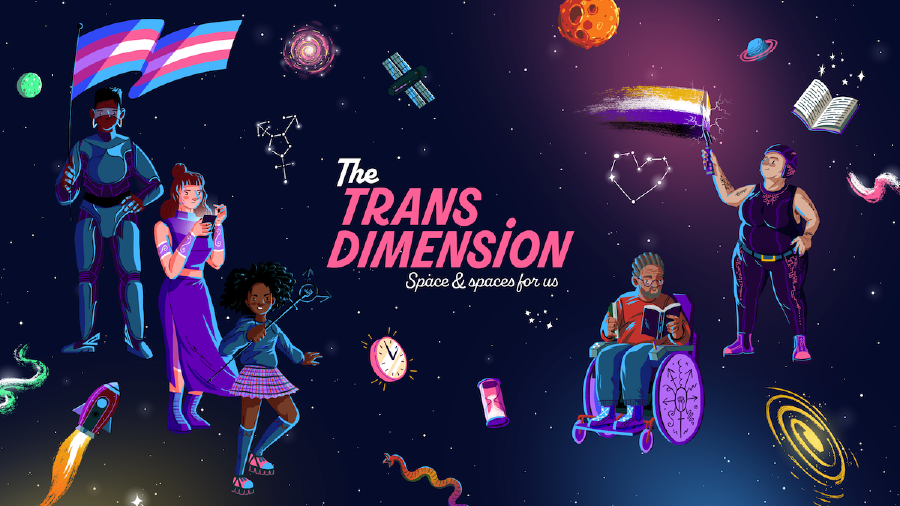
Modern DEI (Diversity, Equity and Inclusion) frameworks can unfortunately be anti-intersectional, seeing diversity and inclusion as a side issue, a problem to be fixed by the benevolant institution (see point 1). We take a view that the most expert analysts are the most marginalised, and that progress comes from understanding their intersections of oppression. For example, trans liberation and disabled liberation are explicitly linked. By forgrounding both as a baseline for inclusion, we can improve things for everybody.
See: Guide to Inclusive Events, Trans Dimension
Epistemology: what counts as knowledge?
How do we know things, who gets to say what’s true, whose experience counts?
No form of knowledge is inherently more important
What a community knows from living somewhere (vernacular knowledge), what a practitioner knows from doing the work (tacit knowledge), and what a researcher knows from studying it (scientific knowledge) are all real forms of knowledge. But they sit in a power relationship that can be uncomfortable and contradictory. Policymakers treat scientific evidence as the gold standard, which means local knowledge and practitioner knowledge get overruled not because they're wrong, but because they don't come with the right credentials or care about publishing it in the ‘correct’ format.
We therefore aim to ground all our work in workshops and conversations that capture the situation as is, not how we wish it to be. We try and document and acknowlege all the different types of knowledge that might contribute to projects.
Document reality, don’t invent it
The most revolutionary thing one can do is always to proclaim loudly what is happening.
– Rosa Luxemburg
Being completely honest about how things actually are makes you suprisingly unpopular. Everyone wishes the world was more like they wished it to be, and is willing to cherry-pick evidence to varying degrees that their version of the world is the most correct one (the stark difference between ‘AI’ discourse on Mastodon and LinkedIn respectively is a good example of this). But the only way we can hope to get shared understanding of collective problems is to start from the painful process of documenting reality, being specific about what we mean, and using our terms consistently.
User stories and use cases must be grounded in real evidence, not invented to justify technology that already exists or to retrospectively justify product decisions already made. David Graber tells us of Caroline Humphrey's conclusion that “no example of a barter economy, pure and simple, has ever been described, let alone the emergence from it of money. All available ethnography suggests that there never has been such a thing”. Nevertheless, Adam Smith managed to shape the entire dicipline of economics' beliefs around this due to telling a convincing story that satisfied the dominant system of power at the time it was written. The world is complicated enough as it is without making things up!
See: CTP Year 1 Report, No False Users, GMP Taser Report

Doing the work IS the research
We aim to collect knowledge first, and worry about what to do with it later. We don’t study communities and then intervene: the intervention is the research. PlaceCal was developed through hands-on day-to-day community development work, not designed in a lab and tested on people (our tech debt is a feature not a bug, *cough*). Complete and messy is the reality of the world, which development processes seek to simplify and systemise so they can sell you projects. We forground and discuss the mess so that we can identify shared problems as our primary form of knowledge generation.
See: Programming is Forgetting: Towards a New Hacker Ethic
Measurement serves power
Goodhart’s Law simply states that when a measure becomes a target, it ceases to be a good measure. This is a recurring structural problem across health (BMI), community work (how many engagements did our funding enable this month?), and user stats (installs and clicks). They stop becoming good measures as they become abstractions of social problems with authoritative names that then become the goal in themselves.
Data and open data cannot independently challenge inequality. Structural inequality is extensively documented but not acted on, because power determines what gets done with evidence. In Ursula Franklins' terms, measurement is the mechanism that converts holistic technologies to prescriptive ones: how many posters per hour are our design team making?
See: Everything is Connected, but Should it be?, Data Is Meaningless Without Social Power, Stop Making Pincushion Maps
Pedagogy: theory and practice of learning
Education is political empowerment, not a series of ‘knowledge deposits’
Freire talks about a ‘banking’ concept of education: teachers make deposits which students receive, file, and store. Most ‘digital inclusion’ programmes work exactly like this – fill people up with the skills to conform to the status quo, and send them on their way.
The logical endpoint is the assumption that all of human knowledge is on the Internet (or eventually will be), so an educator's job is getting people to the point they can access this information online. But this is a colonial idea. Boaventura de Sousa Santos refers to a “monoculture of knowledge” – the belief that only written, formally validated knowledge is ‘real’ knowledge. Linda Tuhiwai Smith starts Decolonising Methodologies with “The word itself, ‘research’, is probably one of the dirtiest words in the indigenous world's vocabulary”, going on to describe how the dicipline of research itself was explicitly used as a colonial tool to divide and rule indiginous societies across subject-area lines.
Internet culture has updated this with a widely held belief that if it's not indexed and searchable, it doesn't count. But most of what matters – how to organise a meeting, how to support a neighbour, how to hold a group together through conflict – isn't something you can learn just by reading. It's knowledge that only exists in practice, between people, in specific contexts. Knowledge is also relational – what we know of each other, how we work together, what we believe: this might be specific just to us, but it is no less ‘real’ than anything published in a book.
Education isn't a deposit into a ‘knowlege bank account’, then. It's what happens when we do what Freire calls “problem-posing”: investigating our shared world together, and in doing so discovering our shared capacity to change things.
See: Freire (Pedagogy of the Oppressed), Social Power of Data
Build infrastructure, avoid reactivity
Everyone’s angry, but anger isn't a strategy in itself. A quick browse on Instagram stories will give you more things to be angry about than you could probably address in a lifetime. Being reactive to every issues as it comes up is exhausting and keeps everyone on the back foot – undoubtedly a large part of the well-documented negative mental health problems associated with regular use of Meta platforms. As long as everyone's chasing their tails instead of building, we have at best a zero sum game: our enemies do things and we get mad and nothing ever changes and we feel more and more disempowered. It feels like the ultimate psy-op.
The entire grassroots and voluntary sector is exhausted due to large-scale removal of state support, cost-of-living crises, and the ongoing impact of the pandemic. It's never felt like there's a bigger demand for grassroots labour and so few people up for sustaining it. If we want to change things we need to invest in community infrastructure and aim to actually collectively own things, not just resist things one at a time, going at a pace that's sustainable for us. This is much easier said than done, of course. Indignities and obstacles come thick and fast nowadays. Burnout is systemic, our nervous systems are fried, and everyone's increasingly disabled. But this is all the more reason to try and act from a place of stability and growth and to support each other to stop trying to address everything all the time.
Of course, a big part of the problem is the grant funding model which seems explicitly designed to cause this kind of reactive burnout. A funder issues a call, organisations scramble to reframe everything into the funder's language. In the base case we then drop everything to deliver a project which inevitably ends and everything collapses. One of the many reasons GFSC have restarted as a volunteer-led collective growing direct donations is so we have a buffer against this cycle. If you'd like to support us it's a huge help that not only helps us publishing but gives us a bit of emotional regularity. We think we are going to see a lot more organisations moving to this model over the coming years!
See: Our Plan to Build Bottom-up Resistance to Billionaire Technology, CTP Year 1 Report, Consensus Decision Making Sucks.
Meet people where they are, don’t shame them for where that is
Shaming people for where they're at is very in right now, and we hate it. None of us choose the conditions of our indentured servitude under capitalism, and all of us are doing our best to make their lives tolerable. Guilt-driven activism is counterproductive, though. We all pick our battles and draw our moral lines differently. There's no ethical consumption under capitalism so getting mad at people for using Microsoft products, AI or the wrong social media sites fundamentally just expands the already growing social rift between the people creating the alternatives, and the mainstream. It also just stresses everyone out and leads to the reactivity problem addressed above.
Our PlaceCal platform is based on this principle: rather than telling anyone they have to install a new app, we just support them to use whatever they already have be it Google Calendar, Outlook, Eventbrite or something else. By helping people out with their problems, we come to a shared understanding of why they are using it and a clear view of the organisational logic that leads to it. In our fieldwork we placed a high emphasis on supporting the person rather than supporting our software. This meant that sometimes we needed to help people with a handful of tech issues before they were in a place to work with us, but once we have a relationship established, we are then in a position to discuss non-corporate alternatives.
See: Pick Your Battles: A Shame Story

Small, informal, messy, local
The most innovative community work comes from groups with no formal structure. Volunteer-run, ad hoc, and temporary work is the vast majority of on-the-ground activity that actually matters, and institutions hate it. As soon as things get more formalised, more funded, more recognised, they very often start reproducing the same oppressive hierarchies, protestant work ethic, groupthink, and burnout as everything else. We value encouraging a plurality of smaller groups that prioritise individual autonomy, friends to do things together without overcomplicating it, and diversity of tactics.
Resist the urge to over-generalise, over-scale, and over-egg things. If we all take a few steps back and do one simple thing really well, not only can we start to build trust between groups but we can start making things emotionally sustainable by not making everything we do about everything there is. What brings you joy, and what do you like to do with others? How can you be useful without coming to represent anything more than yourselves?
See: Consensus Decision Making Sucks, Minimum Viable Organisations, Why is it So Hard to do Nice Things?
Our Methodology: Community Technology Partnerships
How we put these principles into action?
Philosophers have hitherto only interpreted the world in various ways; the point is to change it
– Karl Marx
We've been writing about our approach addressing these ideas, which we have called Community Technology Partnerships (CTPs), for some time now. Rather than starting with a product, the starting point for almost every design methodology out there, a CTP starts with the process of building partnerships of people with shared interests and helping them identify and address problems together.
An overwhelming finding in our fieldwork is that there is no meaningful dividing line between what is experienced as a social problem and what is experienced as a technical one. For example, organising a yoga class involves finding space, having the right social networks, a handle on finance, and promotion. All of these have both a technicial and social aspect. If you can't access your website because you lost the login, because there's a bug, or beacuse the person who set it up moved away a few months ago and you can't find them, the result is the same.
Let's return to our expansive definition of technology: “the systematic treatment of an art, craft, or technique”. Technology is therefore the process of making desirable social activities easier, or undesirable ones harder. Due to our billionare problem, unfortunately the processes which are being prioritised right now are the extraction of wealth and information, the consolidation of power, and the embedding of surveillance into every aspect of life. If we are to resist this we must agree what the processes are we want to make easier, and how we are going to do that together: socially, economically and technologically.
Our last piece on CTPs was about a year ago. We will update the blog soon with more updates on our progress putting this all into practice. What processes do you want to make harder, or easier? Let us know in the comments.
See: How to Establish a Community Technology Partnership, CTP Year 1 Report, Tech Culture is Failing Communities, White & Foale 2020.


Comments ()